Clinical AI Curriculum
A hands-on, 10-chapter clinical AI curriculum designed for radiology fellows and clinical fellows. Every chapter runs end-to-end in a free Colab T4 in roughly 60-90 minutes total. The curriculum is built to be executed, not just read.
Open the Colab notebook :material-rocket-launch: Try the live Gradio demo :material-test-tube: Browse the chapters :material-book-open-page-variant:
Provenance
Adapted from material taught at the Clinical AI Summer School at the Alan Turing Institute in 2023, and used for a clinical radiologist cohort at the University of Southampton in April 2026.
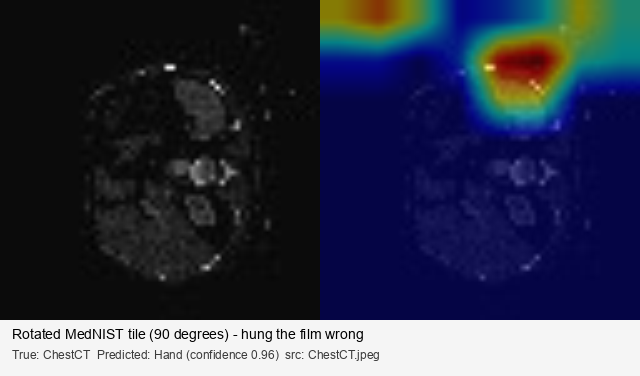
The screenshot above is the pedagogical thesis of the curriculum, in one image. A ChestCT tile rotated 90 degrees, classified as a Hand with 0.96 confidence. The GradCAM heatmap is on the empty corner. The model has not seen the anatomy. This is what radiologists need to learn to recognise.
What is in the curriculum
- One Colab notebook, 113 cells across 10 chapters. CNNs (DenseNet121, ResNet50, EfficientNet), Vision Transformers (ViT-Small), DINOv2 fine-tuning, GradCAM, ViT attention rollout, calibration with ECE, bootstrap confidence intervals, fairness/subgroup analysis, and a 90-minute PCam team challenge.
- 53-term glossary in plain clinical language.
- A live Gradio demo with calibrated probabilities, GradCAM heatmaps, and a permanent "known failure modes" panel.
- A published fine-tuned model with augmentation-induced failure gallery, per-class reliability diagrams, and a path-pinned validation split for exact-reproduction.
Three things worth pointing out
The failure gallery is augmentation-induced, not natural
The fine-tuned model reaches 100% in-distribution validation AUC. The standard "5x6 grid of misclassified val images" approach would have been a grid of "(no failures)" placeholders. So the gallery instead applies 8 clinically-named test-time augmentations (rotated, inverted DICOM window, gaussian noise, motion blur, narrow window, narrow FOV, etc.) and harvests the most-confidently-wrong flips. In-distribution accuracy and shift robustness become visibly different properties.
Reproducibility is via val_indices.json, not a seed
The published validation split is a literal list of MedNIST-relative paths, sha256-pinned. Anyone can reload the model and reproduce the reported AUC on exactly the same examples, invariant across torch and sklearn version drift.
Multi-architecture explainability comparison in one notebook cell
The same 4 misclassified test images run through DenseNet121 (GradCAM on denseblock4), ViT-Small (attention rollout), and DINOv2-Small (attention rollout) on the same axes. The disagreement between explanations is the most pedagogically useful signal: clinicians need to know "the heatmap" is method-dependent.
Where to start
- Learner? Getting started walks you through opening the notebook in Colab and what to expect.
- Curriculum designer or clinical educator? Contributing explains how to fork-and-adapt for your own cohort.
- Browsing for ideas? Description explains the unusual design choices.